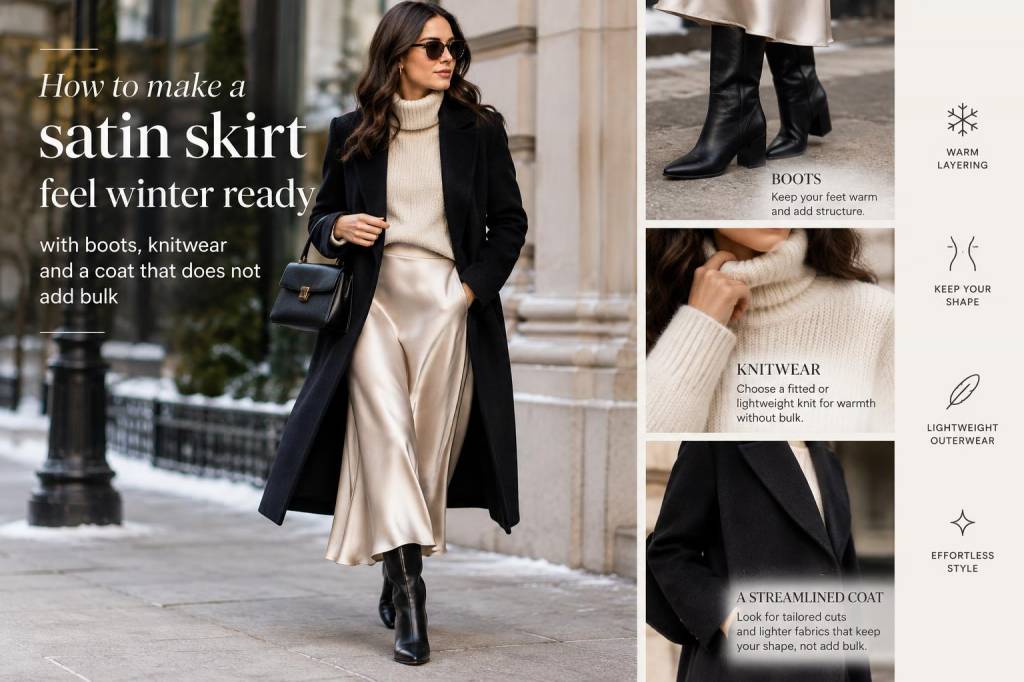
I reach for a satin skirt far more often in winter than people expect, because it solves a very real styling problem: I want something that feels polished, feminine, and a little fluid against all the heavy textures I naturally wear once the temperature drops. The challenge is not whether a satin skirt can work in cold weather. It absolutely can. The real question is how to make it feel intentional rather than like a summer piece I have accidentally carried into November.
For me, the secret is balance. Satin brings shine and movement, so I like to anchor it with pieces that add structure, warmth, and visual weight in just the right places. Boots ground the look, knitwear makes it feel seasonally correct, and a coat with a smart cut keeps everything streamlined. If I get those three elements right, the skirt stops reading as delicate or out of place and starts feeling like one of the most versatile items in my wardrobe.
Start With A Satin Skirt That Has A Winter-Friendly Shape
I always think about silhouette first. A satin skirt can be bias-cut, straight, midi-length, or softly flared, and each version changes the mood of the outfit. In colder months, I find midi lengths easiest because they work beautifully with boots and still give enough coverage to feel practical. If the skirt skims the body instead of clinging, it also layers more easily over tights without creating awkward lines.
Colour matters too. In winter, I am drawn to deeper shades such as chocolate, charcoal, navy, forest green, or black because they feel richer and easier to pair with heavier outerwear. That does not mean lighter satin is off limits, but a deeper tone often makes the outfit feel more grounded. A soft champagne skirt can look lovely in winter, yet I usually style it with sharper contrast, such as black boots and a dark knit, so it feels deliberate rather than seasonal drift.
Fabric finish also affects how luxe the look appears. A satin with a subtle sheen feels more expensive to me than something overly glossy. When the surface is too shiny, it can become harder to combine with winter textures like wool, cashmere, or brushed alpaca. A softer sheen tends to blend better with knitwear and outerwear, which is exactly what I want.
Choose Boots That Give The Outfit Weight
Boots do a huge amount of work here. They visually “winterise” the skirt immediately, and they help keep the look from feeling too airy. My go-to options are ankle boots, knee-high boots, and sock boots, depending on the shape of the skirt and the amount of leg I want to show.
Ankle boots work well when the hem of the skirt lands just above the boot shaft, because that gap creates a clean line. I prefer a sleek leather pair with a pointed or slightly almond toe, since that shape makes the skirt feel more refined. Chunkier ankle boots can still work, but I use them when I want the outfit to feel more casual or a little tougher.
Knee-high boots are my favourite choice when I want warmth without adding visual bulk. They pair especially well with midi satin skirts because they create a continuous line under the hem. If the boots are slim through the calf, the whole outfit looks elegant and elongated. I often wear them with a skirt that has a gentle drape, because the contrast between fluid fabric and polished leather feels very current.
When I want the outfit to look slightly more fashion-forward, I sometimes choose a heeled boot with a close fit around the ankle. That small fit detail matters more than people realise. A boot that sits neatly under a skirt hem makes the whole look feel considered, while a slouchy or oversized boot can add too much volume unless I deliberately want that effect.
If I am styling a satin skirt with tights, I usually keep the tights opaque and close to the boot colour. That creates one continuous lower half, which is a simple way to keep the outfit sleek. It also helps the satin stand out as the focal point instead of competing with lots of visual breaks.
Use Knitwear To Add Warmth Without Losing Shape
Knitwear is where I see most people overcomplicate the look. The aim is not to pile on as much knit as possible. It is to choose a sweater that adds texture and warmth while still allowing the skirt to keep its elegant line. I usually think in terms of proportion rather than trend.
A fine-knit roll neck is one of my favourite pairings because it tucks or half-tucks easily and gives a neat finish under a coat. It keeps the upper half slim, which balances the softer shape of satin. I like this especially when the skirt is cut on the bias, because the combination of fluid fabrics feels cohesive rather than heavy.
For a more relaxed look, I often wear an oversized crewneck or a slightly boxy cardigan with a waistband defined enough to show where my shape sits. A loose knit works best when the skirt has enough structure to offset it. I usually half-tuck the front of the jumper or let a shorter knit skim the waistband so the silhouette does not disappear.
If I want a more polished outfit, a cashmere knit in a neutral tone always feels right. Cream, camel, grey, and black are especially easy to style with satin. I love tonal dressing in winter because it makes the satin feel rich rather than fragile. A charcoal knit with a black or graphite skirt can look incredibly elegant, and the different textures do all the talking.
Texture contrast is what really matters. Satin against ribbed knit, cable knit, brushed wool, or cashmere gives the outfit depth. I avoid anything too fuzzy if the skirt is already very glossy, because too many competing finishes can make the outfit feel messy. One soft texture is usually enough.
Pick A Coat That Frames, Rather Than Hides, The Outfit
This is where bulk can become a problem, so I pay attention to coat shape very carefully. I want warmth, but I do not want to bury the skirt under layers that erase the silhouette. A winter coat should frame the outfit, not flatten it.
A tailored wool coat is usually my first choice. The clean shoulder line and straight cut create structure, which helps balance the satin underneath. If the coat falls to mid-calf or slightly below the skirt hem, the outfit feels calm and elongated. I especially like single-breasted coats because they tend to look less heavy than double-breasted styles.
When I want something a little softer, I choose a wrap coat with a belt. This works well because I can define my waist before the fabric drops away, which keeps the whole outfit from feeling bulky. I like to tie the belt lightly rather than cinch it too tightly, since I want ease as well as shape.
Longline coats are excellent with satin skirts because they create one continuous vertical shape. If the coat is too short, the layers underneath can feel chopped up, especially when paired with boots. A longer coat gives the outfit a sense of intention. I often leave it open when I am indoors or moving between places, because that is when the skirt gets to be seen properly.
I usually avoid overly padded coats or coats with very large lapels when I am styling a satin skirt. Those details can overwhelm the delicacy of the fabric. Instead, I look for cleaner lines, a smooth finish, and a weight that sits close to the body without clinging. Even a heavy wool coat can feel light if it is cut well.
My Favourite Outfit Formulas For Cold Weather
I come back to a few combinations again and again because they are simple and reliable. These are the ones that make me feel put together without much effort:
- A black midi satin skirt, black knee-high boots, a slim cream roll neck, and a charcoal tailored coat
- A chocolate satin skirt, pointed ankle boots, a camel cashmere jumper, and a long wool coat
- A navy satin skirt, sleek black boots, a grey ribbed knit, and a belted wrap coat
- A forest green satin skirt, leather ankle boots, a fitted black cardigan, and a straight wool coat
- A champagne satin skirt, dark brown boots, a soft oatmeal knit, and a clean black coat
What I like about these combinations is that they all use the same formula: shine, texture, structure, and vertical line. Once I have that formula in mind, I can swap colours or fabrics without losing the overall effect.
Small Styling Details That Stop The Look From Feeling Bulky
The small choices matter more than people think. If I want a satin skirt outfit to stay sleek, I make sure my knit does not bunch awkwardly at the waist. I prefer a neat tuck, a half-tuck, or a knit that ends exactly where the skirt begins. That keeps the middle of the body defined.
I also think about sock height, belt width, and bag shape. A very bulky bag or oversized scarf can tip the balance in the wrong direction. Instead, I like one strong accessory, such as a structured leather bag or simple earrings, and I let the fabric contrast do the rest.
If I am wearing tights, I choose opaque styles that blend into the boots or sit close to the colour of the skirt. That creates a smoother line and makes the whole outfit feel more intentional. In colder weather, this small trick often makes a bigger difference than adding another layer.
Even the way I wear my coat can change the final effect. Leaving it open when possible gives more movement and reveals the skirt’s fluid shape. When I button it up, I make sure the coat has enough room through the body so it does not pull across the hips or create stiffness. A coat that fits properly is one of the easiest ways to avoid bulk.
| Element | What I look for | Why it works |
|---|---|---|
| Skirt | Midi length, soft sheen, easy drape | Feels seasonal and moves well with boots |
| Boots | Sleek ankle or knee-high shape | Adds weight and sharpens the silhouette |
| Knitwear | Fine knit or textured but not bulky | Brings warmth without overwhelming the skirt |
| Coat | Tailored, longline, or belted | Frames the outfit and avoids visual heaviness |
When I style a satin skirt for winter, I am really thinking about contrast and control. I want softness, but not fragility; warmth, but not weight; polish, but not stiffness. Once those elements are balanced, the skirt feels completely at home in the colder months, and it becomes one of the easiest pieces to dress up or down with very little effort.