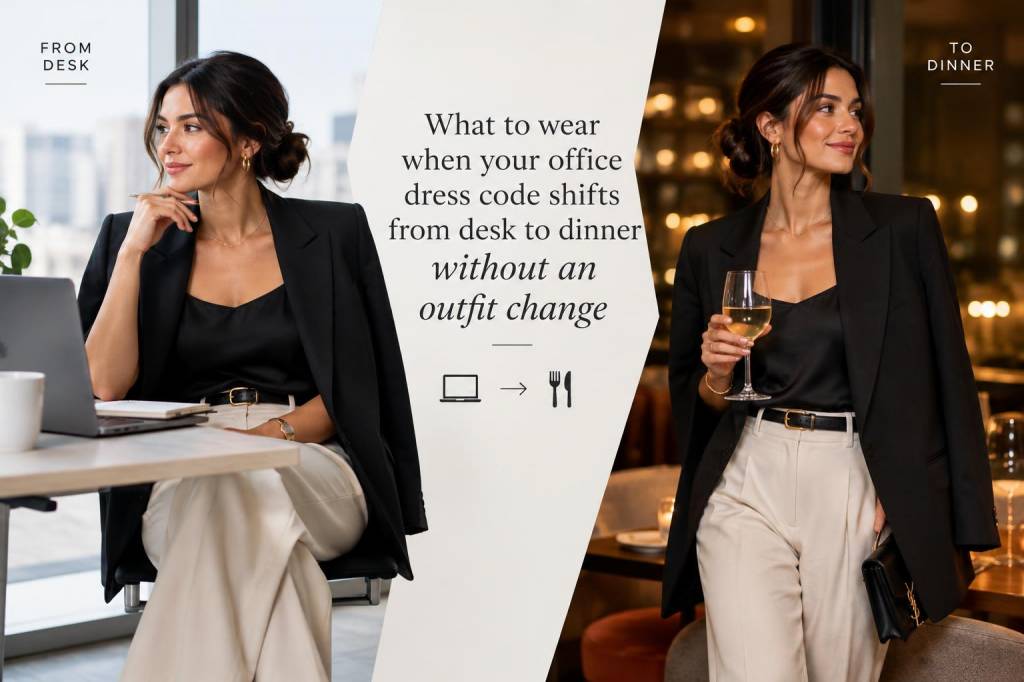
I know the feeling of standing in front of my wardrobe at 7:45 a.m., choosing an outfit that needs to carry me from a morning meeting to an evening dinner, and hoping it can survive both worlds without a costume change. When an office dress code shifts from desk to dinner, I do not want to overpack, overthink, or spend the day feeling either too corporate for the evening or too dressed up for the office. I want a look that feels polished at my desk, relaxed enough for after hours, and flexible enough to adapt with only a few small adjustments.
Over time, I have learned that this kind of dressing is less about owning a separate “day” wardrobe and more about building a smart base. I start with pieces that carry structure, then soften or elevate them depending on where the day takes me. That approach has saved me from many outfit emergencies, and it has also made getting dressed feel much calmer. I do not need a full change; I need a few strategic choices.
Start with a refined base that does not feel overworked
When I need one outfit to do double duty, I usually begin with a foundation that already feels slightly elevated. My favourite starting points are straight-leg trousers, a sleek midi skirt, a softly tailored blazer, or a knit dress with a clean silhouette. These pieces give me enough polish for a professional setting, but they do not feel so rigid that I cannot relax in them later.
I like fabrics that hold their shape but still move well. A lightweight wool blend, ponte, crepe, and fine merino all work beautifully because they look intentional without being fussy. If I wear denim, I choose a dark wash with a clean finish, because distressed jeans rarely make the leap from office to dinner with enough ease. The same goes for tops: I prefer something with structure or texture, such as a crisp shirt, a ribbed knit, or a satin cami layered under a blazer.
My rule is simple: if the base feels too casual, the evening styling has to work much harder. If the base already feels elegant, everything else becomes easier.
Choose a colour palette that can shift with one accessory swap
I rely heavily on colour when I want versatility. Neutral tones make this whole process much simpler. Black, navy, ivory, camel, charcoal, chocolate brown, and deep olive all create a strong base that can read professional during the day and chic at night. I can add interest through texture, shine, or one statement detail without fighting the outfit itself.
When I wear colour, I prefer muted or rich shades rather than anything overly bright. Burgundy, forest green, cobalt, and soft plum all feel intentional in both settings. I find that these shades look especially good with metallic accessories in the evening, which is one of my favourite ways to transform a daytime outfit with very little effort.
If I know I will be heading out after work, I avoid colours that are difficult to accessorise. That does not mean I avoid personality; it just means I build a palette that can move from sharp to relaxed or from simple to sophisticated with only a bag, shoe, or lip change.
Use layers as your secret weapon
Layers are what make this kind of dressing possible for me. A blazer is the obvious choice, but I also love a trench coat, a fine knit cardigan, or a sleeveless waistcoat worn over a shirt. These pieces let me look pulled together in the office and then create a different mood later in the day.
A blazer is especially useful because it can make almost anything feel more deliberate. I will wear it with tailored trousers, a midi skirt, or even a simple knit and straight jeans if the office is less formal. Later, I can drape it over my shoulders, roll the sleeves, or swap it for a lighter outer layer to make the look feel less managerial and more dinner-ready.
I also pay attention to the neckline of what I layer underneath. A neat crew neck feels classic, a V-neck feels slightly softer, and a shirt worn open at the collar can be adjusted during the day depending on how formal I need to look. Small changes like unbuttoning the top button or removing a scarf can completely shift the tone of an outfit.
Make shoes do part of the work
Shoes change everything. If I want an outfit to feel appropriate for the office and still stylish for dinner, I usually choose shoes that sit in the middle rather than at either extreme. Low block heels, sleek loafers, pointed flats, ankle boots, and streamlined mules are all reliable options for me.
During the day, I might wear loafers or low heels for comfort and structure. In the evening, if I have time, I will switch into a more refined pair of heels or a sharper shoe shape. Even when I do not change footwear, a pointed toe or a polished finish can instantly make an outfit feel more evening-friendly.
I have found that shoes are one of the easiest places to express personality without breaking a dress code. A patent loafer, a satin slingback, or a minimal heel in metallic leather can feel office-appropriate and dinner-ready at the same time.
Let accessories carry the evening mood
This is where I have the most fun. Accessories are my fastest route from desk to dinner because they can change the energy of an outfit without altering its practicality. I often keep the day version of my look quite minimal, then layer in more personality later.
For example, I might wear simple gold hoops, a leather tote, and a neat watch during the day. Then, before dinner, I swap the tote for a smaller bag, add a bolder earring, and choose a more interesting belt or bracelet. That alone can make the whole outfit feel different.
I also love the power of texture. A satin clutch, a croc-effect belt, a chain strap bag, or sculptural jewellery can transform a straightforward office outfit into something more evening-appropriate. If I am wearing very simple clothes, I use accessories to create the sense of occasion. If my clothes already feel strong, I keep the accessories sleek and restrained.
Use one beauty change to shift the whole outfit
I never underestimate the effect of a small beauty adjustment. If I am heading directly from work to dinner, I do not need a full beauty routine reset. I just need one or two changes that help the outfit feel more finished.
My favourite quick switches are a deeper lip colour, a touch more mascara, a softer wave in my hair, or a slightly glossier complexion. If I have worn my hair neatly tied back during the day, I might release it into loose waves or a smooth blow-dry for the evening. If I have kept my makeup very light, I may add a little definition around the eyes and a more polished lip colour.
I like beauty changes that feel subtle rather than dramatic. They help me look more awake and more intentional without making it seem as if I have started from scratch.
Build outfit formulas that already work in both settings
I have a handful of outfit formulas I return to whenever my day needs to stretch. They work because they are balanced, easy to adjust, and comfortable enough to wear for long hours.
- Tailored trousers, fine knit top, blazer, loafers, and a structured bag
- Midi skirt, tucked shirt, ankle boots, and a slim belt
- Dark jeans, silk blouse, sharp blazer, and pointed flats
- Knit dress, trench coat, low heels, and minimal jewellery
- Wide-leg trousers, sleeveless top, cardigan, and slingback shoes
What I love about these combinations is that they already contain contrast. Something tailored is paired with something softer. Something simple is elevated with texture. That balance is what keeps an outfit from feeling too rigid at work or too casual at dinner.
Keep one small kit in your bag
When I know I will not have time to go home, I like to keep a tiny style kit with me. It is nothing dramatic, just a few things that make a real difference when the day runs long. I usually carry a lipstick or lip tint, blotting papers, a compact mirror, a hair tie, and a small pair of earrings or a bracelet if I know I will want to change accessories later.
I also keep a small pair of foldable flats in my car or work bag when I know I will be on my feet a lot. That gives me the option to protect my energy during the day and still look polished enough for the evening.
It is not about being prepared for every possible scenario. It is about making sure I do not feel stuck in an outfit that only works for one moment of the day.
Know when to stay simple and when to add drama
One thing I have learned is that desk-to-dinner dressing is not always about adding more. Sometimes the smartest move is to keep the outfit clean and let one element do the talking. A beautifully cut blazer, a great pair of shoes, or an elegant neckline can be enough.
On other days, I want a little more drama, and I add it through a statement earring, a stronger lip colour, or a richer texture like satin or leather. The key is not to pile everything on at once. I always ask myself whether the outfit already feels strong. If it does, I only need one shift. If it feels plain, I add two or three thoughtful changes.
| Day Element | Evening Shift | Effect |
|---|---|---|
| Blazer | Wear over shoulders or swap for lighter layer | Creates a softer, more relaxed mood |
| Loafers | Pointed heels or sleek mules | Instantly feels sharper |
| Work tote | Small clutch or crossbody bag | Makes the outfit feel more polished |
| Natural makeup | Deeper lip and more definition | Adds evening energy without a full reset |
| Simple jewellery | Statement earrings or layered gold pieces | Brings personality and focus |
I love this kind of dressing because it respects real life. My day does not stop at 5 p.m., and my outfit should not either. When I get the balance right, I feel prepared, comfortable, and quietly confident from my desk straight through to dinner.