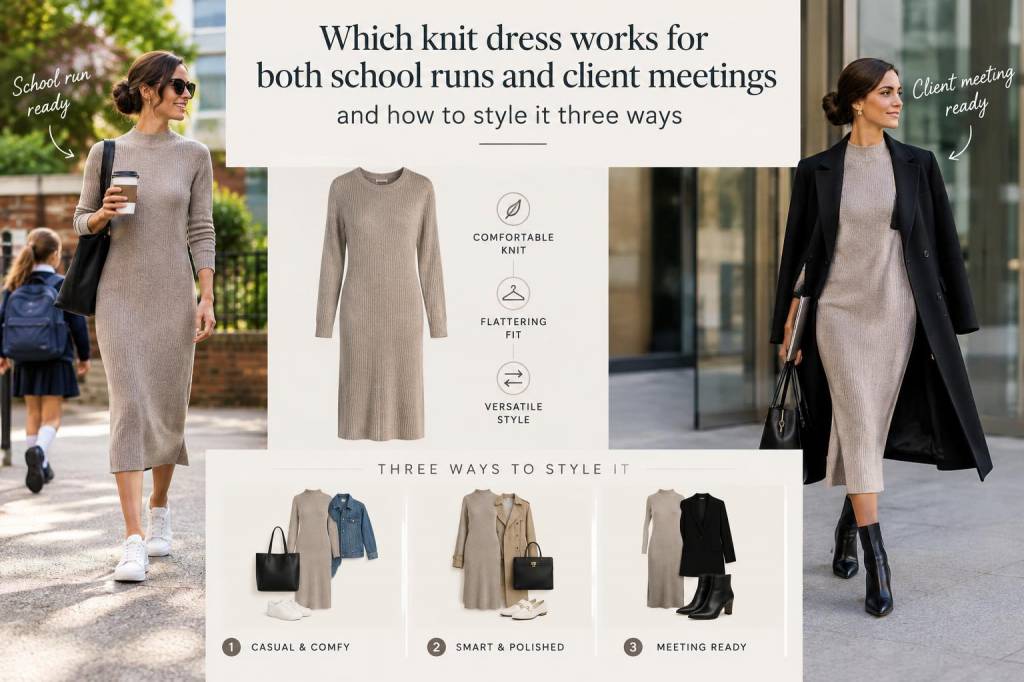
When I want one piece that can handle a messy, real-life morning and still look polished enough for a client meeting, I reach for a midweight midi knit dress with a clean column shape. It is the style I trust most because it does not cling too tightly, it does not feel too precious, and it gives me enough structure to look intentional without sacrificing comfort. If I had to narrow it down even further, I would choose a ribbed knit dress in a fine-to-medium gauge, with a crew neck or gentle mock neck, sleeves that hit near the wrist or mid forearm, and a hem that lands below the knee or at mid calf.
That shape works because it solves two different dressing problems at once. For school runs, I need movement, warmth, and ease. For client meetings, I need polish, calm lines, and a look that feels put together within seconds. A good knit dress can do both if the fabric has enough weight to skim rather than cling. The wrong knit can look too slouchy, too body-conscious, or too casual. The right one feels like a shortcut to looking organised, which is exactly what I want on a busy day.
What I look for in a knit dress
I have tried enough knit dresses to know that small details matter more than trend labels. The most useful version is usually simple, but not plain. I want fabric that holds its shape, a neckline that frames the face, and a silhouette that follows the body without gripping every curve. A dress with subtle ribbing often works better than a flat knit because the texture adds visual interest and makes the outfit feel more refined.
These are the details I reach for most:
- Midweight fabric that feels substantial and smooth
- Midi length for versatility with flats, boots, or heels
- Straight or lightly fitted shape instead of a clingy bodycon cut
- Neutral shades such as black, charcoal, navy, chocolate, or camel
- Minimal hardware and clean seams for a smarter finish
- Sleeves with enough coverage to work from morning to evening
If I am choosing one for maximum flexibility, I usually skip anything too chunky, oversized, or highly decorative. Chunky knits can feel cosy, but they often add volume in places I do not want it. Oversized dresses can look effortless in theory, yet they sometimes lose shape by lunchtime. I want something that stays sleek from the first coffee run to the last meeting of the day.
Why this shape works across both settings
What makes this style so useful is the balance between comfort and structure. The knit fabric gives the softness and stretch I need when I am lifting bags, sitting in the car, or running after children, while the column shape keeps the outfit from looking too relaxed. It feels almost like wearing a jersey dress, but with a more elevated finish.
A midi knit dress also creates a strong base for layering. That matters because my mornings are never identical. Some days I need a coat over it, some days a blazer, and some days a chunky scarf. A dress like this can take all three without fighting for attention. It acts as a neutral canvas, which makes styling much easier.
I also find that this silhouette works well with accessories. If I want to lean casual, I can add trainers and a crossbody bag. If I want to look sharper, I can add a belt, a structured tote, and a pointed shoe. The dress does not dictate the mood; it adapts to it.
First look: school run with polished ease
For the school run, I keep everything practical but still intentional. I want to look like I made an effort, even if I dressed in five minutes. My favourite version pairs the knit dress with clean trainers, a long coat, and a crossbody bag. If the weather is cold, I add opaque tights and ankle boots instead of trainers.
This is the formula I rely on:
- Midweight midi knit dress in a neutral shade
- White or off-white trainers with a simple silhouette
- Oversized wool coat or a tailored trench, depending on season
- Crossbody bag that leaves my hands free
- Small hoop earrings or studs for a neat finish
What keeps this from looking too casual is the coat. A good coat instantly lifts even the simplest dress, especially if the knit is otherwise very understated. I like a straight wool coat in camel, grey, or navy because it gives the whole outfit a smarter edge. If I wear a darker dress, I sometimes choose lighter outerwear to create contrast and stop the look from feeling heavy.
For hair, I usually go with a low bun, soft ponytail, or loose waves pulled back from my face. I want the outfit to feel tidy, not fussy. On school-run mornings, I find that a neat hairstyle does more for an outfit than an extra accessory ever could.
Second look: client meeting with quiet authority
When I need the same dress to feel meeting-ready, I build around structure. A knit dress can look professional if I add sharper lines and more polished textures. My favourite approach is to wear it with a tailored blazer, heeled ankle boots or pointed flats, and a structured tote.
This version feels deliberate because it introduces contrast. The dress stays soft and comfortable, while the blazer gives shape at the shoulders and waist. I like a blazer that is not too oversized, because a very large jacket can drown the clean lines of the dress. A slightly boxy fit usually works beautifully. It says polished without feeling stiff.
My meeting formula looks like this:
- Same midi knit dress, ideally in black, navy, charcoal, or deep brown
- Single-breasted blazer with a defined shoulder
- Pointed flats or low block heels
- Structured tote or top-handle bag
- Fine gold jewellery for a subtle finish
I also pay attention to the hemline. If the dress is just below the knee or mid calf, it tends to look more composed with a blazer. If it is too short, the outfit can feel less balanced for a work setting. A longer hem creates a steadier silhouette, especially when I am sitting in meetings or moving between appointments.
Makeup matters here too, even if it is minimal. I usually go for groomed brows, a bit of concealer, mascara, and a neutral lip. I do not want the outfit to depend on a full face of makeup, but I do want my appearance to look awake and considered.
Third look: off duty, but still styled
My third version is the one I wear when I want the dress to feel more relaxed without losing its shape. This is the outfit I would choose for coffee with a friend, a casual lunch, or a day when I need to feel comfortable but not underdressed. I swap the blazer for a fine knit cardigan or a leather jacket, then add ankle boots or sleek loafers.
This is my easiest formula for a softer, more relaxed mood:
- Midi knit dress in a rich neutral or muted tone
- Short leather jacket, cropped cardigan, or denim jacket with clean lines
- Ankle boots, loafers, or ballet flats
- Soft shoulder bag or slouchy tote
- Layered necklace or simple watch
I especially like this version when I want the dress to feel less office-like and more lived in. A leather jacket gives it edge, while a cardigan makes it feel gentle and approachable. If I want a slightly French-feeling look, I add loafers and a neat coat, then keep the rest very simple. If I want a more relaxed weekend mood, I choose flats and a loose bag.
One thing I avoid is over-accessorising. A knit dress already has presence because of its texture and shape, so too many add-ons can make the outfit feel busy. A single good bag, one layer of jewellery, and shoes with a clean line are usually enough.
Colour, texture, and proportion matter more than I used to think
The longer I wear knit dresses, the more I notice that styling success often comes down to proportion. If the dress is fitted, I balance it with a sharper outer layer. If the dress is straighter, I let the accessories add definition. If the knit is very smooth, I sometimes choose suede boots or a textured bag to bring depth into the outfit. If the knit is ribbed, I keep the rest of the look simpler so the texture can do the work.
Colour also changes everything. Black feels strongest for meetings and easiest for winter. Camel and chocolate feel warm and elegant. Grey is understated and modern. Navy can be a nice alternative to black when I want something softer. If I am buying one dress to do many jobs, I usually avoid very bright colours or loud patterns, because they can limit how often I reach for it.
Here is a simple comparison I often use when deciding how to wear it:
| Setting | Shoes | Outer Layer | Bag | Overall Mood |
|---|---|---|---|---|
| School run | Trainers or flat boots | Wool coat or trench | Crossbody | Practical and polished |
| Client meeting | Pointed flats or low heels | Tailored blazer | Structured tote | Calm and professional |
| Off duty | Loafers, boots, or ballet flats | Cardigan or leather jacket | Soft shoulder bag | Relaxed and refined |
What I would buy if I wanted only one
If I were choosing just one knit dress for this exact purpose, I would pick a ribbed midi dress in a dark neutral, with a straight fit and a modest neckline. I would want sleeves that work on their own, so I am not forced to rely on a cardigan every time. I would also want enough thickness that I can wear it with confidence, even when the weather changes through the day.
In practical terms, I would look at pieces from brands that consistently do clean knitwear well, such as & Other Stories, Massimo Dutti, Whistles, COS, or Mango. I would prioritise fabric content, shape, and length over trend details. If a dress can work with trainers at 8 a.m. and a blazer at 2 p.m., that is usually a sign it will earn its place in my wardrobe.
The real secret is not finding a dress that does everything on its own. It is choosing one strong base piece that lets me move between roles without changing my whole identity for the day. That is why I keep returning to the same kind of knit dress: it gives me comfort, confidence, and enough polish to meet whatever is on my calendar.